
Love it or hate it, Rate My Professor (RMP) is a resource used by many students to help them choose their classes. If you are not familiar with RMP, it is a site where students post reviews of their professors. It’s like a Yelp for post-secondary education. For professors, it is a cause of consternation, but can also be a source of useful feedback. However, interpreting that feedback to help improve our teaching practice can be daunting.
I can’t help myself from checking for reviews about me at least a couple of times a year. I am probably the most rated professor in my college’s faculty. Note that I did not say that I am the most HIGHLY rated professor. My average rating is 3.7 out of 5. Students would say that’s just a B grade; nothing to brag about.
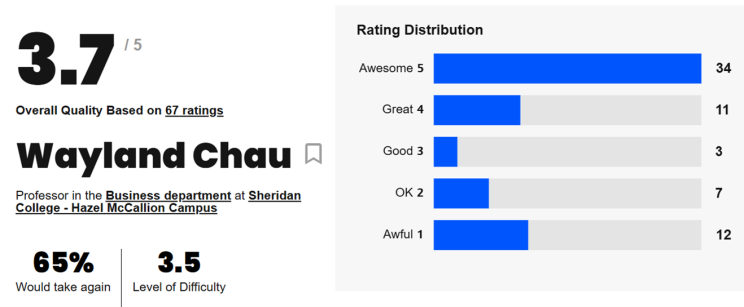
Sometimes, I wish my overall rating was a four or a five, but I am actually quite happy with my 3.7 rating and the reviews posted about me. Looking at the rating distribution, I am either loved or hated, with very few in between. I am heartened that the lovers outnumber the haters by more than two to one.
After having seen my RMP ratings and reviews, students who sign up for my classes know that they will be challenged and that they need to push themselves a bit harder than usual to succeed. They know that my class will not be an easy “A”. That’s a good thing.
My overall rating is reflective of how I approach teaching. It is an approach that challenges students to fully use their capabilities and to go beyond. I challenge them both academically and intellectually. I often get my students to question and assess their views and perspectives. Personal growth usually happens from a place of discomfort or disjuncture. I often intentionally create that discomfort or disjuncture in my students. Many of them react positively with a growth mindset, but inevitably some others retreat to a defensive posture and react with frustration. Many of my positive reviews are from students who understand the learning and growth they have experienced from my class. In an albeit smaller number of negative reviews, other students did not understand or appreciate “the method behind my madness”.
It can be emotionally difficult reading the reviews. The students that are motivated enough to post a review on RMP probably have some axe to grind either in favour of or against a prof. There’s the love: “Amazing prof”, “pretty cool prof”, “Favourite prof!”, and “Chau’s a great guy”. And there’s the hate: “Worst prof”, “AVOIDDDDDD!!!!”, “STRICTEST PROF”, and “He is not the best prof”.
After sifting away the expletive-laden adulation and vitriol, there are golden nuggets of feedback to be had. Whoever said feedback is a gift, never mentioned that sometimes you have to go on a scavenger hunt to find it. RMP helps with that hunt by identifying the “top tags”.

For the record, I agree with all of my top tags. The tags, at least superficially, are an accurate reflection of me and how I teach. However, like most things in social media, a mere hashtag phrase does not adequately convey deeper underlying meanings and nuances.
“Tough grader” is the phrase mentioned most often in my reviews. In most of those reviews, being a tough grader was clearly a criticism of me. Common comments were similar to “If you want to save your gpa do not take with him.” or “He is not the best prof. He is a very tough grader.” I was not surprised by these comments since I expect a lot from my students and I hope that they expect just as much or more from me. A part of me wears the title of “tough grader” as a badge of honour in the defence of high academic standards. However, if I were to stop at just that, it would be self indulgent. I am sure my tough grader reputation drove many students away from registering for my classes. .
I started thinking about the underlying emotions behind the “tough grader” comments. In response, I did not relax my grading standards, but I have learned to be more balanced in my feedback acknowledging both the good and the bad. I started communicating negative feedback in a more constructive manner with positive word choices and specific guidance on how to improve. I have more impromptu, casual conversations in class about what I am trying to achieve for my students from a learning perspective. In other words, I helped my students understand the “method behind my madness”.
In more recent reviews, the “tough grader” tag is still being mentioned but in a more positive light as a part of my general approach towards improving and helping students. Students were saying:
“I never thought I would rate my professor, but he deserves it. He gives you tough grades and makes you work hard, but it’s because he wants you to do well. His lectures are engaging and so interesting if you participate and study before class. Overall, would definitely take another class with him. Amazing prof”
“He’s a tough grader who pushes you to work hard, but it’s because he genuinely cares about your success. His lectures are engaging if you participate, and even if you don’t master the material, you’ll grow in work ethic and character. He’s one of the rare professors who truly invests in his students’ futures. But the guy is tough, be prepared.”
I am heartened that students seem to be taking ownership of their education by acknowledging the need to challenge themselves for their personal growth. The tough grader seems to have transformed from a villain to a hero. What more could I ask for?


 The Reflective Prof