ChatGPT and Critical Thinking: The Rosetta Stone for Deciphering Doublespeak

We have all read or heard it, or even drafted some of it ourselves.  Carefully crafted, formal communications – written or verbal – that are filled with elaborate and complex language. Language that conveys information but, simultaneously, confuses, obfuscates or deflects.  When what is left unsaid is just as, or even more, important than what is explicitly stated. 

This form of communication goes by many names — some more polite than others. Corporate-speak. Corporatese. Bureaucratese. Gobbledygook. Word salad. Doublespeak. Or, simply, b.s. It is almost a different language that requires translation and interpretation.

Much like the ancient Rosetta Stone unlocked hidden meanings in Egyptian hieroglyphs, modern AI tools like ChatGPT can help decode this doublespeak. In this article, I explain how I used ChatGPT to help me develop a deep critical understanding of a contentious communication I received.  In that process, I also learned something more significant about how human critical thinking remains indispensable in the age of AI. 

Decoding Doublespeak: ChatGPT as a Critical Thinker

Every organization employs language as a tool of persuasion, sometimes using euphemisms and jargon to obscure true intentions. Typical doublespeak often operates on multiple levels:

  • Surface Meaning: The literal meaning of the words in the communication.
  • Contextual Meaning: Underlying themes, motives or biases arising from the tone, framing, and choice of words.
  • Meaning by Omission: Insights revealed by what is left unsaid.

On a whim, I decided to use ChatGPT as a “Rosetta Stone” to help me understand the true meaning of a mass-issued email letter from a college president to all faculty and staff about a difficult financial restructuring that involved program cuts and layoffs. (See the full letter at Appendix A.) As a faculty member of that college, when I first read the letter, I was initially confounded by the wording and sensed deeper, implied meanings.  I wondered whether there was more to uncover. 

As a casual but interested user of AI since it became mainstream, I had heard that ChatGPT and other generative AI tools were capable of critical thinking, but had not actually seen it with my own eyes — until now. 

When I asked ChatGPT to “critically interpret” the letter, my expectations were modest. At most, I hoped for a plain English explanation of the letter’s literal wording. What I actually received was a multi-layered analysis far beyond simple translation. (See ChatGPT’s interpretation at Appendix B and my full conversation with ChatGPT at Appendix C.)

ChatGPT’s analysis involved:

  1. Literal Translation:  ChatGPT re-wrote the letter in clear, accessible language, simplifying complex phrases so that key facts, such as enrollment targets and budget cuts, were easy to understand. 
  1. Examining Tone and Framing:  ChatGPT highlighted how the letter used language, such as “swift, strategic action”, to create a sense of urgency. It also noted phrases like “our shared future”, “together, we must unlock new opportunities” and “every one of you has an important role” as suggesting an effort to gain buy-in from faculty and staff. ChatGPT commented that this framing serves dual purposes of motivating immediate action while potentially suppressing dissent or critical discussion.  
  1. Interrogating Strategic Priorities: ChatGPT examined each strategic priority mentioned in the letter and questioned its underlying implications:
  • Strategic Enrollment and Program Optimization: It suggested that “program optimization” might be a euphemism for cutting unprofitable academic programs, and shifting focus from educational quality to financial metrics. ChatGPT also noted a move towards “a more centralized, efficiency-focused model rather than one centered on traditional academic autonomy”.
  • Financial Sustainability and Operational Efficiency: ChatGPT linked a 30% budget contraction and additional savings goals to probable consequences for faculty and staff, such as job cuts, hiring freezes, and increased workloads.  While “efficiency” could be viewed positively, it speculated that it could mean larger class sizes, fewer student services, and reduced academic and research funding.
  • Revenue Growth & Financial Resilience: The hiring of external consultants Deloitte to identify potential “non-enrollment sources of income” was interpreted by ChatGPT as signalling “a shift away from traditional postsecondary values toward a more market-driven, commercialized approach to education”.
  1. Highlighting What’s Left Unsaid:  ChatGPT was particularly insightful in analyzing the omissions. By pointing out that the letter avoids directly mentioning potential layoffs, faculty workload increases or reductions in student support, the analysis suggests that the underlying reality may be more severe than the optimistic surface language implies. ChatGPT raised the risks of prioritizing revenue over education including academic integrity, equity and accessibility for students, and “more centralized and less faculty-driven” academic decision-making. It went further by commenting that, although change is framed as being done “together”, the apparent reality is that these decisions are top-down as there is no mention of “shared governance, faculty consultation, or opportunities for staff input”.
  1. Synthesizing Final Insights: ChatGPT provided some powerful and provocative final thoughts. It rhetorically asked, “A Business-Oriented Vision of Education?”.  It said the letter signals a fundamental shift that “prioritizes financial efficiency and market-driven decision-making over traditional academic structures”. Ultimately, ChatGPT questioned the overall vision presented by the leadership. It raised concerns about “the corporatization of higher education”, “the erosion of faculty influence and academic freedom”, and the pursuit of a “short-term, reactive approach rather than a long-term vision for meaningful educational innovation”.

Getting ChatGPT to Think Critically

How did I get ChatGPT to provide its insightful critical analysis of the letter? It was as simple as asking it to “critically interpret”.  There was no magical prompt engineering involved to trigger its critical thinking. I did not provide any additional context, background, or parameters for critical assessment. 

In my full conversation with ChatGT, my first prompt was “Can you interpret this letter in plain language?”, and I then copied and pasted the letter. After copying and pasting the letter, ChatGPT responded with a clear, straightforward rewrite.  My second and last prompt was: “Instead [sic] just rewriting the letter, can you critically interpret the letter?” 

It seems that the simple phrase of “critically interpret” was enough to prompt ChatGPT to provide a complex critical analysis of the letter.  I have since asked ChatGPT to “critically interpret” other communications I have written or received.  In all cases, it has provided similar levels of critical insight.

In a separate conversation, I asked ChatGPT a couple of general questions.

You said: Are you able to think critically?

ChatGPT said: Yes, I can think critically! I can analyze information, evaluate arguments, identify biases, and solve problems logically. While I don’t have personal opinions or emotions, I can assess different perspectives, recognize inconsistencies, and help you refine your reasoning. What do you need help thinking through?

You said: Can you provide critical commentary?

ChatGPT said: Absolutely! I can provide critical commentary on a wide range of topics, including literature, philosophy, current events, scientific theories, and more. My analysis can include strengths, weaknesses, logical consistency, implications, and alternative viewpoints.

I would have to agree with ChatGPT.

Is Human Critical Thinking Still Important?

Now that generative AI is able to think critically with minimal prompting, do humans still need to develop critical thinking skills? Should educators still focus on teaching critical thinking?  It would be easy – too easy — to let AI take on most of the cognitive heavy lifting of critical thought. 

Being able to think independently, analytically, critically, ethically, and creatively is what makes us human.  The limitations of AI and the inherent abilities of human thinking need to be recognized. In particular:

  • Thinking Beyond Data Patterns: AI’s interpretations and insights are derived from existing patterns and prior data. Humans can look beyond the historical data to generate innovative perspectives by applying creativity, empathy, and ethical judgment.
  • Contextual Judgment: Human thinkers are uniquely positioned to question assumptions, challenge biases, and consider broader societal implications. When an AI highlights that “program optimization” may mean cutting courses, human experts can further investigate and weigh the long-term impacts on educational quality, workforce development, and community engagement.
  • Ethical Considerations:  AI can provide critical analysis, but ethical decision-making is inherently human. Ethics is based on human values and morals.  As in the subject matter of the letter, in making difficult management decisions, educational leaders must lean on their values and morals in striking an ethical balance between efficiency and financial sustainability versus the broader values of equity, academic freedom, and social responsibility.

A Complementary Partnership

The ability to independently and critically decipher information is all the more important in today’s world where the value of information is becoming increasingly based on the power that the information enables the user to wield, instead of the actual truth and accuracy of the information. This human ability can be developed, complemented and leveraged by AI

Rather than viewing AI as a replacement for human thought, we should see it as a tool that augments our critical thinking capabilities. Educators can use AI’s critical methodology as a model to help students learn how to dissect complex arguments, identify themes and biases, and understand the importance of questioning what’s left unsaid.  The value of original human thought — infused with creativity, empathy, and ethical judgment — must remain paramount. 

Appendix A – Email letter from college president to all faculty and staff (All proper names have been removed.)

Our change vision and top priorities

Colleagues: since January 2024, we’ve been moving at a rapid pace to respond to the complex forces of change facing the postsecondary sector in Canada.

The social, economic, political and technological headwinds we’re facing are serious and unrelenting. What is at stake isn’t just one program or service—it’s our shared future. If we hesitate, lose focus or allow uncertainty to hold us back our vision, impact and financial viability will be at risk.

2025 will be a pivotal year as we undertake the transformational redesign of [name of college]. Together, we must unlock new opportunities, lead with vision and adapt strategically to prove our essential role in knowledge creation, shaping industries and fostering community well-being.

Even in the face of complex and competing forces, postsecondary education has never been more vital to our graduates, industry partners, communities, provinces and country. We are the boots on the ground to grow and shape the future.

Today, I want to provide an update on our work to contract and adapt. Specifically, I want to share our top priorities as we navigate this critical period in [name of college]’s history.

Our top 3 priorities

 To position [name of college] for the future, we are focused on three critical priorities: program optimization and strategic enrolment, financial sustainability and operational efficiency, and revenue growth.

Every one of you has an important role to play in their fulfilment:

1. Drive recovery and growth through program optimization and strategic enrolment management

Students—current and prospective—remain at the heart of all our decisions. Without them, there is no [name of college].

Our goal is to reduce the projected enrolment decline from 37% to 21% by 2027-2028. To do this, our #1 priority is clear: we must increase enrolment.

Maximizing our Provincial Attestation Letter (PAL) utilization and filling international student seats must be everyone’s top priority. Second, we need to strengthen domestic recruitment efforts to capture more market share in an increasingly competitive landscape.

We are reimagining our program mix and delivery model at an unprecedented pace, using a centralized, strategic approach to address enrolment challenges and respond to labour market needs. Our work goes beyond launching new programs: it’s about optimizing existing strengths, refining course structures, and making targeted investments to ensure adaptability and long-term success.

Some changes will be transformational, like designing entirely new programs, while others will build on our existing infrastructure to create a more efficient, market-responsive model. This complex transformation is ongoing, with program reviews and approval processes actively underway.

In parallel, we are immediately allocating more resources to recruit students for both new programs and existing programs that have capacity and/or demand for higher enrolment. This includes targeted campaigns designed to heighten awareness, increase engagement, and drive more applications to offers and acceptances.

2. Ensure financial sustainability & operational efficiency

Our long-term financial health requires tough but strategic decisions to reduce expenditures.

We will continue to contract the organization by 30%, which will involve identifying a total of $134M in expense reductions.

Our goal for 2025-26 is to collectively realize additional expense savings of $70M through organizational redesign, process optimization and operational expense reduction.

You will hear from [name], our Chief Finance Officer, closer to the end of the month with a comprehensive finance update.

3. Transform [name of college] to drive revenue growth & financial resilience

The traditional postsecondary model is no longer viable. We must seek out alternative revenue sources to remain financially sustainable and intensify our impact. Our goal is to increase the percentage of revenue we generate from non-enrolment sources from 1.4% to 5% in the next five years.

We will diversify revenue growth by responding to the demand for lifelong learning, career evolution, and intellectual engagement. To inform and expedite this work, we have partnered with Deloitte and are nearing completion of an assessment to identify potential opportunities. The next phase of this work will evolve over the spring and focus on developing preliminary proposals for consideration.

What to expect

Change can be a double-headed arrow—both challenging and energizing. Along the way, breakthroughs will unfold concurrently, setbacks will come alongside successes and difficult decisions will intersect with exciting opportunities.

I want to be very clear: every decision we are making is to ensure our viability while maintaining our vibrancy.

We remain unwavering in our mission to cultivate highly skilled, creative and resourceful people and communities through collaboration, active learning and the relentless incubation of new ideas.

This journey will not be without challenges, but we’ll move forward together—with clarity, purpose and an unwavering commitment to our mission. And if we do this right, [name of college] will shape and lead the next chapter in postsecondary education.

Throughout all of this, I remain committed to keeping you informed and providing clarity where needed.

Thank you for everything you do. More updates will follow soon.

Sincerely,

[name]

President and Vice Chancellor

Appendix B – ChatGPT’s critical interpretation of the letter in Appendix A (Note: No emphases were added. All bolded text is from the original text by ChatGPT.) (All proper names have been removed.)

The full conversation with ChatGPT is in Appendix C. 

ChatGPT said:

Certainly! Here’s a critical interpretation of the letter, analyzing its key messages, implications, and potential concerns.

1. The Tone and Framing of the Message

The letter presents a sense of urgency and inevitability regarding changes at [the college]. The language emphasizes serious external pressures (economic, political, and technological challenges) and the need for swift, strategic action to secure the institution’s future.

  • Crisis Framing: The letter sets up the idea that failure to act quickly will threaten “our shared future,” implying that tough decisions are non-negotiable.
  • Reinforcing a Collective Mission: Phrases like “Together, we must unlock new opportunities” and “every one of you has an important role” suggest an effort to gain buy-in from faculty and staff.

While this approach can motivate action, it can also suppress dissent or critical discussion by framing change as urgent and unavoidable rather than open to debate.


2. Strategic Priorities: What They Really Mean

Priority 1: Enrollment Growth and Program Optimization

The letter places enrollment growth as the top priority, with particular emphasis on international students through Provincial Attestation Letters (PALs) and strengthening domestic recruitment.

  • Why the Focus on International Students? International students often pay higher tuition fees, making them a key revenue source. The emphasis on “filling international student seats” suggests a financial rather than purely educational motivation.
  • Program Optimization = Program Cuts? The letter suggests reimagining and restructuring programs, which could mean:
    • Expanding market-driven programs (e.g., tech, business, health sciences).
    • Reducing or eliminating less profitable programs (often in the arts, humanities, or niche academic fields).
    • Moving towards a more centralized, efficiency-focused model rather than one centered on traditional academic autonomy.

Priority 2: Financial Sustainability and Cost Reductions

A 30% contraction in expenditures ($134M in cuts) and an additional $70M in savings for 2025-26 indicate significant restructuring.

  • Impact on Faculty and Staff: This level of cost-cutting will almost certainly result in job losses, hiring freezes, and workload increases. The letter does not explicitly mention layoffs, but given the scale of savings needed, staff reductions seem inevitable.
  • Operational Efficiency = Fewer Resources? While “efficiency” is presented as a positive, it could mean:
    • Larger class sizes
    • Fewer student services
    • Reduced academic and research funding

This signals a shift toward a leaner, more corporate-style operation, which may conflict with traditional academic values.

Priority 3: Revenue Growth Beyond Tuition

[Name of college] aims to increase revenue from non-enrollment sources from 1.4% to 5% in five years, with Deloitte assisting in identifying opportunities.

  • Why Deloitte? Hiring a major consulting firm suggests that [name of college] is looking at corporate strategies for financial sustainability. This often leads to:
    • More industry partnerships (e.g., corporate training programs, applied research contracts).
    • Expanding non-degree offerings (microcredentials, professional development courses).
    • Monetizing institutional resources (e.g., renting facilities, corporate sponsorships).

While diversifying revenue is necessary, it may also signal a shift away from traditional postsecondary values toward a more market-driven, commercialized approach to education.


3. What’s Left Unsaid?

  • How Will This Affect Faculty, Staff, and Students?
    The letter avoids directly mentioning potential layoffs, faculty workload increases, or student experience changes. The reality is that cost-cutting at this scale likely means staff reductions, fewer course offerings, and potential declines in student support services.
  • What Are the Risks of Prioritizing Revenue Over Education?
    The emphasis on market-driven decisions and financial viability raises concerns about:
    • Academic integrity: Will programs be shaped more by financial incentives than educational value?
    • Equity and accessibility: Will tuition rise or services decline for students, especially marginalized ones?
    • Faculty governance: Will academic decision-making become more centralized and less faculty-driven?
  • What Role Do Faculty and Staff Have in Decision-Making?
    The letter frames change as something being done “together”, but the reality is that many of these decisions seem top-down. There’s no mention of shared governance, faculty consultation, or opportunities for staff input.

4. Final Thoughts: A Business-Oriented Vision of Education?

This letter signals a fundamental shift in how [name of college] operates, prioritizing financial efficiency and market-driven decision-making over traditional academic structures. While adapting to external challenges is necessary, this approach raises concerns about:

  • The corporatization of higher education (with a focus on revenue streams rather than educational mission).
  • The potential erosion of faculty influence and academic freedom in decision-making.
  • A short-term, reactive approach rather than a long-term vision for meaningful educational innovation.

[name of college]’s leadership presents these changes as a necessary evolution, but the trade-offs should not be ignored. If cost-cutting and enrollment goals overshadow the core mission of education, the long-term consequences could be weakened academic integrity, overworked faculty, and a diminished student experience.

Appendix C – Full conversation between ChatGPT-4o and Wayland Chau on 19 February 2025

You said:

Can you interpret this letter in plain language?

ChatGPT said:

Sure! Please upload or paste the letter, and I’ll interpret it in plain language for you.

You said:

Our change vision and top priorities

Colleagues: since January 2024, we’ve been moving at a rapid pace to respond to the complex forces of change facing the postsecondary sector in Canada.

The social, economic, political and technological headwinds we’re facing are serious and unrelenting. What is at stake isn’t just one program or service—it’s our shared future. If we hesitate, lose focus or allow uncertainty to hold us back our vision, impact and financial viability will be at risk.

2025 will be a pivotal year as we undertake the transformational redesign of [name of college]. Together, we must unlock new opportunities, lead with vision and adapt strategically to prove our essential role in knowledge creation, shaping industries and fostering community well-being.

Even in the face of complex and competing forces, postsecondary education has never been more vital to our graduates, industry partners, communities, provinces and country. We are the boots on the ground to grow and shape the future.

Today, I want to provide an update on our work to contract and adapt. Specifically, I want to share our top priorities as we navigate this critical period in [name of college]’s history.

 Our top 3 priorities

To position [name of college] for the future, we are focused on three critical priorities: program optimization and strategic enrolment, financial sustainability and operational efficiency, and revenue growth.

Every one of you has an important role to play in their fulfilment:

1. Drive recovery and growth through program optimization and strategic enrolment management

Students—current and prospective—remain at the heart of all our decisions. Without them, there is no [name of college].

Our goal is to reduce the projected enrolment decline from 37% to 21% by 2027-2028. To do this, our #1 priority is clear: we must increase enrolment.

Maximizing our Provincial Attestation Letter (PAL) utilization and filling international student seats must be everyone’s top priority. Second, we need to strengthen domestic recruitment efforts to capture more market share in an increasingly competitive landscape.

We are reimagining our program mix and delivery model at an unprecedented pace, using a centralized, strategic approach to address enrolment challenges and respond to labour market needs. Our work goes beyond launching new programs: it’s about optimizing existing strengths, refining course structures, and making targeted investments to ensure adaptability and long-term success.

Some changes will be transformational, like designing entirely new programs, while others will build on our existing infrastructure to create a more efficient, market-responsive model. This complex transformation is ongoing, with program reviews and approval processes actively underway.

In parallel, we are immediately allocating more resources to recruit students for both new programs and existing programs that have capacity and/or demand for higher enrolment. This includes targeted campaigns designed to heighten awareness, increase engagement, and drive more applications to offers and acceptances.

2. Ensure financial sustainability & operational efficiency

Our long-term financial health requires tough but strategic decisions to reduce expenditures.

We will continue to contract the organization by 30%, which will involve identifying a total of $134M in expense reductions.

Our goal for 2025-26 is to collectively realize additional expense savings of $70M through organizational redesign, process optimization and operational expense reduction.

You will hear from [name], our Chief Finance Officer, closer to the end of the month with a comprehensive finance update.

3. Transform [name of college] to drive revenue growth & financial resilience

The traditional postsecondary model is no longer viable. We must seek out alternative revenue sources to remain financially sustainable and intensify our impact. Our goal is to increase the percentage of revenue we generate from non-enrolment sources from 1.4% to 5% in the next five years.

We will diversify revenue growth by responding to the demand for lifelong learning, career evolution, and intellectual engagement. To inform and expedite this work, we have partnered with Deloitte and are nearing completion of an assessment to identify potential opportunities. The next phase of this work will evolve over the spring and focus on developing preliminary proposals for consideration.

 What to expect

 Change can be a double-headed arrow—both challenging and energizing. Along the way, breakthroughs will unfold concurrently, setbacks will come alongside successes and difficult decisions will intersect with exciting opportunities.

I want to be very clear: every decision we are making is to ensure our viability while maintaining our vibrancy.

We remain unwavering in our mission to cultivate highly skilled, creative and resourceful people and communities through collaboration, active learning and the relentless incubation of new ideas.

This journey will not be without challenges, but we’ll move forward together—with clarity, purpose and an unwavering commitment to our mission. And if we do this right, [name of college] will shape and lead the next chapter in postsecondary education.

Throughout all of this, I remain committed to keeping you informed and providing clarity where needed.

Thank you for everything you do. More updates will follow soon.

Sincerely,

[name]

President and Vice Chancellor

ChatGPT said:

Here’s a plain-language interpretation of the letter:


Summary of Key Points from [name of college]’s Leadership

[name of college] is undergoing significant changes due to challenges in the postsecondary sector, including economic, political, and technological shifts. The college must adapt quickly to remain financially stable and continue serving students and the community effectively.

Three Main Priorities for the Future:

  1. Increasing Student Enrollment
    • Enrollment is declining, and [name of college] aims to reduce the projected drop from 37% to 21% by 2027-28.
    • The focus is on increasing both international and domestic student enrollment through improved recruitment strategies and program offerings.
    • Programs are being reviewed, updated, and restructured to better match labor market needs and attract more students.
    • More resources will be allocated to marketing and recruiting for programs that have space for additional students.
  2. Reducing Costs and Improving Efficiency
    • The college plans to reduce its expenses by 30%, or $134 million, through restructuring and process improvements.
    • For the 2025-26 academic year, the goal is to cut an additional $70 million in expenses.
    • More details on financial strategies will be shared by the Chief Finance Officer later this month.
  3. Finding New Sources of Revenue
    • [name of college] wants to rely less on tuition fees and generate more money from other sources, increasing non-enrollment revenue from 1.4% to 5% over the next five years.
    • This could include lifelong learning programs, professional development courses, and industry partnerships.
    • [name of college] has hired Deloitte to help identify new revenue opportunities, with updates on this plan coming in the spring.

What This Means for Faculty and Staff

  • Expect continued changes as [name of college] adapts to financial challenges and enrollment shifts.
  • Some changes will be difficult, but they are necessary to keep [name of college] financially stable and competitive.
  • Leadership promises to keep staff informed and provide updates as plans develop.

Final Message

[name of college]’s leadership acknowledges the challenges ahead but believes that with clear direction and teamwork, the college can emerge stronger and play a key role in shaping the future of postsecondary education.


This version keeps the key details while making the message clearer and more straightforward. Let me know if you’d like any further simplifications or edits!

You said:

Instead [sic] just rewriting the letter, can you critically interpret the letter?

ChatGPT said:

Certainly! Here’s a critical interpretation of the letter, analyzing its key messages, implications, and potential concerns.


1. The Tone and Framing of the Message

The letter presents a sense of urgency and inevitability regarding changes at [name of college]. The language emphasizes serious external pressures (economic, political, and technological challenges) and the need for swift, strategic action to secure the institution’s future.

  • Crisis Framing: The letter sets up the idea that failure to act quickly will threaten “our shared future,” implying that tough decisions are non-negotiable.
  • Reinforcing a Collective Mission: Phrases like “Together, we must unlock new opportunities” and “every one of you has an important role” suggest an effort to gain buy-in from faculty and staff.

While this approach can motivate action, it can also suppress dissent or critical discussion by framing change as urgent and unavoidable rather than open to debate.


2. Strategic Priorities: What They Really Mean

Priority 1: Enrollment Growth and Program Optimization

The letter places enrollment growth as the top priority, with particular emphasis on international students through Provincial Attestation Letters (PALs) and strengthening domestic recruitment.

  • Why the Focus on International Students? International students often pay higher tuition fees, making them a key revenue source. The emphasis on “filling international student seats” suggests a financial rather than purely educational motivation.
  • Program Optimization = Program Cuts? The letter suggests reimagining and restructuring programs, which could mean:
    • Expanding market-driven programs (e.g., tech, business, health sciences).
    • Reducing or eliminating less profitable programs (often in the arts, humanities, or niche academic fields).
    • Moving towards a more centralized, efficiency-focused model rather than one centered on traditional academic autonomy.

Priority 2: Financial Sustainability and Cost Reductions

A 30% contraction in expenditures ($134M in cuts) and an additional $70M in savings for 2025-26 indicate significant restructuring.

  • Impact on Faculty and Staff: This level of cost-cutting will almost certainly result in job losses, hiring freezes, and workload increases. The letter does not explicitly mention layoffs, but given the scale of savings needed, staff reductions seem inevitable.
  • Operational Efficiency = Fewer Resources? While “efficiency” is presented as a positive, it could mean:
    • Larger class sizes
    • Fewer student services
    • Reduced academic and research funding

This signals a shift toward a leaner, more corporate-style operation, which may conflict with traditional academic values.

Priority 3: Revenue Growth Beyond Tuition

[name of college] aims to increase revenue from non-enrollment sources from 1.4% to 5% in five years, with Deloitte assisting in identifying opportunities.

  • Why Deloitte? Hiring a major consulting firm suggests that [name of college] is looking at corporate strategies for financial sustainability. This often leads to:
    • More industry partnerships (e.g., corporate training programs, applied research contracts).
    • Expanding non-degree offerings (microcredentials, professional development courses).
    • Monetizing institutional resources (e.g., renting facilities, corporate sponsorships).

While diversifying revenue is necessary, it may also signal a shift away from traditional postsecondary values toward a more market-driven, commercialized approach to education.


3. What’s Left Unsaid?

  • How Will This Affect Faculty, Staff, and Students?
    The letter avoids directly mentioning potential layoffs, faculty workload increases, or student experience changes. The reality is that cost-cutting at this scale likely means staff reductions, fewer course offerings, and potential declines in student support services.
  • What Are the Risks of Prioritizing Revenue Over Education?
    The emphasis on market-driven decisions and financial viability raises concerns about:
    • Academic integrity: Will programs be shaped more by financial incentives than educational value?
    • Equity and accessibility: Will tuition rise or services decline for students, especially marginalized ones?
    • Faculty governance: Will academic decision-making become more centralized and less faculty-driven?
  • What Role Do Faculty and Staff Have in Decision-Making?
    The letter frames change as something being done “together”, but the reality is that many of these decisions seem top-down. There’s no mention of shared governance, faculty consultation, or opportunities for staff input.

4. Final Thoughts: A Business-Oriented Vision of Education?

This letter signals a fundamental shift in how [name of college] operates, prioritizing financial efficiency and market-driven decision-making over traditional academic structures. While adapting to external challenges is necessary, this approach raises concerns about:

  • The corporatization of higher education (with a focus on revenue streams rather than educational mission).
  • The potential erosion of faculty influence and academic freedom in decision-making.
  • A short-term, reactive approach rather than a long-term vision for meaningful educational innovation.

[name of college]’s leadership presents these changes as a necessary evolution, but the trade-offs should not be ignored. If cost-cutting and enrollment goals overshadow the core mission of education, the long-term consequences could be weakened academic integrity, overworked faculty, and a diminished student experience.


Would you like a deeper analysis on any specific aspect, such as how these changes align with broader trends in higher education?
Posted in Uncategorized | Tagged , , , , | Leave a comment

Scale: Why Sheridan College Needs a Business School

“Scale” or “scalability” refers to the capacity of a business or organization to adapt to increased demand or workload without incurring significant additional costs or effort.

If you have watched enough Dragons’ Den, you know that the ability to scale can make or break a business. It can be the difference between operating a modest mom-and-pop shop that provides a decent living and running a thriving, sustainable enterprise that enriches its owners and benefits many employees and customers.

Scalability is essential for any business or organization, including colleges and universities. Without scalable programs, institutions risk financial instability, particularly during periods of economic uncertainty or enrollment challenges.

How should Sheridan College consider scalability in its process of cutting costs and programs? Will the restructured Sheridan have enough ability to scale to be financially sustainable?

The Cuts at Sheridan College

On 26 November 2024, Sheridan College President and Vice-Chancellor Janet Morrison announced sweeping cuts to staff, faculty, and programs across the college. She stated, “We anticipate 30% fewer students, which will result in a loss of $112 million in revenue in our next fiscal year alone.” To address this, Sheridan will contract by 25% to 30% in an effort to remain a “financially sustainable and vibrant community.”

A closer examination of the announced program “suspensions” reveals that Sheridan’s faculty of business, the Pilon School of Business (PSB), will bear a disproportionate share of these cuts. Thirteen business programs, including flagship BBA degree programs, will be shuttered. These suspensions cut to the very core of PSB’s offerings, effectively dismantling the faculty and decimating its student population. Core business disciplines, such as accounting, finance, and human resources, will be eliminated. The few remaining programs will be insufficient to justify the moniker of a “business school”, let alone a separate faculty within the college. PSB faculty members have aptly described the cuts as a “death sentence” for the Pilon School of Business.

President Morrison framed the cuts within a strategic vision to “maintain our focus on creative industries and build on our strengths in health innovation, skilled trades, and technology, such as advanced manufacturing.” Notably absent from this vision is any mention of business education. The implied message is clear: business education is no longer a priority at Sheridan, and there may no longer be a need for a separate faculty of business.

Post-Secondary Budgetary Pressures and the Role of Business Schools

Ontario’s post-secondary institutions are under increasing budgetary strain due to a domestic tuition freeze, insufficient government funding, and significant projected declines in international enrollment. To mitigate looming operating deficits, many colleges and universities are announcing cost-cutting measures, including faculty and staff layoffs and program cancellations.

However, focusing solely on cost-cutting is short-sighted. To achieve financial stability, post-secondary institutions must also prioritize revenue generation, particularly through programs that can be scaled up or down to meet demand with minimal incremental costs.

Business schools can be a critical part of a solution. Most colleges and universities house a school or faculty of business, which often serves as a substantial and reliable source of revenue. Business programs are inherently scalable and offer practical, applied education that equips students with the skills needed to succeed in the economy. For many students, particularly those from disadvantaged backgrounds, a business degree is a pathway to upward economic mobility.

From an institutional perspective, business programs have the advantage of scalability. Most business courses require minimal infrastructure and resources. Business programs, typically, do not depend on specialized equipment or facilities. A qualified instructor and a classroom equipped with basic tools such as a whiteboard, projector, and Wi-Fi are often sufficient. In fact, a decade ago, I taught an undergraduate business law class at a university using nothing more than a blackboard and chalk.

By leveraging the scalability of business programs, colleges and universities can establish reliable revenue streams that support their overall financial sustainability.

A Critical Question for Sheridan’s Future

Will the reimagined Sheridan College, without a viable business school, be financially sustainable? While creative industries, health, skilled trades, and technology may align with Sheridan’s new vision, programs in those areas are often resource-intensive and lack scalability.  

For many years, PSB has been a significant financial contributor to Sheridan College. PSB’s programs have generated the revenue needed to sustain other faculties, whose programs often require specialized equipment, such as high-performance computers, tools, kilns, and machinery, and specialized facilities like labs, workshops, studios, and theatres. 

PSB’s success as a financial pillar has been significantly driven by the inherent scalability of its business programs. Most of what PSB needs to add a program, a course or a class are qualified instructors and classrooms, with little or no incremental capital expenses.  The faculty has been able to rapidly scale up new and existing programs to meet growing demand, particularly the past surge in international enrollment. 

Now, with international enrollment projected to decline sharply, Sheridan plans to dismantle PSB’s core programs. Instead of scaling back these offerings to adjust to the new enrollment landscape, Sheridan is choosing to discard them altogether. By dismantling PSB, Sheridan is removing a key financial pillar without a clear strategy to replace it.

Scaling back, instead of cancelling, PSB’s key programs would provide an opportunity to redesign and remarket to address current market conditions. We can build on our strengths in doing so. 

If Sheridan is to remain a financially sustainable and vibrant institution, it must preserve and prioritize scalable programs. PSB has demonstrated its ability to meet this need for many years. Its elimination jeopardizes not only Sheridan’s financial future but also the broader mission of providing accessible, practical education that elevates students economically and socially.

Sheridan needs a business school. Without it, the College risks losing its ability to scale, sustain, and serve.

Posted in Uncategorized | Leave a comment

Rate My Professor: Loved or hated? Villain or hero?

Love it or hate it, Rate My Professor (RMP) is a resource used by many students to help them choose their classes. If you are not familiar with RMP, it is a site where students post reviews of their professors. It’s like a Yelp for post-secondary education.  For professors, it is a cause of consternation, but can also be a source of useful feedback. However, interpreting that feedback to help improve our teaching practice can be daunting.

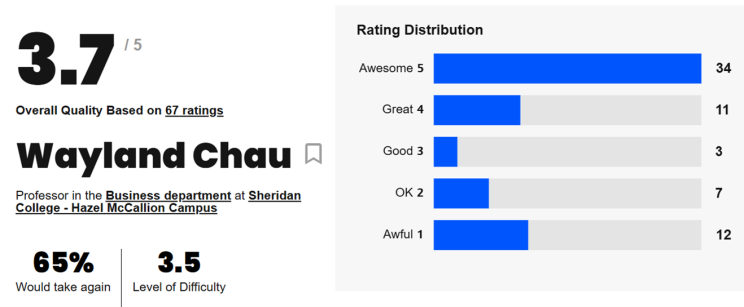
I can’t help myself from checking for reviews about me at least a couple of times a year. I am probably the most rated professor in my college’s faculty.  Note that I did not say that I am the most HIGHLY rated professor. My average rating is 3.7 out of 5. Students would say that’s just a B grade; nothing to brag about. 

Sometimes, I wish my overall rating was a four or a five, but I am actually quite happy with my 3.7 rating and the reviews posted about me. Looking at the rating distribution, I am either loved or hated, with very few in between. I am heartened that the lovers outnumber the haters by more than two to one.  

After having seen my RMP ratings and reviews, students who sign up for my classes know that they will be challenged and that they need to push themselves a bit harder than usual to succeed. They know that my class will not be an easy “A”.  That’s a good thing. 

My overall rating is reflective of how I approach teaching.  It is an approach that challenges students to fully use their capabilities and to go beyond. I challenge them both academically and intellectually.  I often get my students to question and assess their views and perspectives. Personal growth usually happens from a place of discomfort or disjuncture.  I often intentionally create that discomfort or disjuncture in my students. Many of them react positively with a growth mindset, but inevitably some others retreat to a defensive posture and react with frustration. Many of my positive reviews are from students who understand the learning and growth they have experienced from my class.  In an albeit smaller number of negative reviews, other students did not understand or appreciate “the method behind my madness”.  

It can be emotionally difficult reading the reviews. The students that are motivated enough to post a review on RMP probably have some axe to grind either in favour of or against a prof. There’s the love: “Amazing prof”, “pretty cool prof”, “Favourite prof!”, and “Chau’s a great guy”.  And there’s the hate: “Worst prof”, “AVOIDDDDDD!!!!”, “STRICTEST PROF”, and “He is not the best prof”. 

After sifting away the expletive-laden adulation and vitriol, there are golden nuggets of feedback to be had. Whoever said feedback is a gift, never mentioned that sometimes you have to go on a scavenger hunt to find it. RMP helps with that hunt by identifying the “top tags”.

For the record, I agree with all of my top tags. The tags, at least superficially, are an accurate reflection of me and how I teach. However, like most things in social media, a mere hashtag phrase does not adequately convey deeper underlying meanings and nuances. 

“Tough grader” is the phrase mentioned most often in my reviews.  In most of those reviews, being a tough grader was clearly a criticism of me.  Common comments were similar to “If you want to save your gpa do not take with him.” or “He is not the best prof. He is a very tough grader.” I was not surprised by these comments since I expect a lot from my students and I hope that they expect just as much or more from me. A part of me wears the title of “tough grader” as a badge of honour in the defence of high academic standards. However, if I were to stop at just that, it would be self indulgent. I am sure my tough grader reputation drove many students away from registering for my classes. .

I started thinking about the underlying emotions behind the “tough grader” comments. In response, I did not relax my grading standards, but I have learned to be more balanced in my feedback acknowledging both the good and the bad. I started communicating negative feedback in a more constructive manner with positive word choices and specific guidance on how to improve.  I have more impromptu, casual conversations in class about what I am trying to achieve for my students from a learning perspective. In other words, I helped my students understand the “method behind my madness”. 

In more recent reviews, the “tough grader” tag is still being mentioned but in a more positive light as a part of my general approach towards improving  and helping students. Students were saying:

“I never thought I would rate my professor, but he deserves it. He gives you tough grades and makes you work hard, but it’s because he wants you to do well. His lectures are engaging and so interesting if you participate and study before class. Overall, would definitely take another class with him. Amazing prof”

“He’s a tough grader who pushes you to work hard, but it’s because he genuinely cares about your success. His lectures are engaging if you participate, and even if you don’t master the material, you’ll grow in work ethic and character. He’s one of the rare professors who truly invests in his students’ futures. But the guy is tough, be prepared.”

I am heartened that students seem to be taking ownership of their education by acknowledging the need to challenge themselves for their personal growth. The tough grader seems to have transformed from a villain to a hero. What more could I ask for?

Posted in Uncategorized | Leave a comment

My message to students this semester

With another semester of remote online teaching and learning about to start, I will be posting this message to my students:

Welcome to BBA Business Law. I want to convey to you the learning environment that I hope we can create together this semester.   In separate announcements in the next few days, you will be provided with information on what you need to do for the first week of this semester and how our virtual classes will work.

For obvious reasons, this course is being delivered fully online throughout this semester. However, we will still have a classroom – a virtual one.  You will still learn the same things.  You will be developing the same skills. You will be challenged in the same ways. 

Your learning in this course is structured in three parts: pre-class work, in-class work, and post-class work.  Pre- and post-class work has always been set up to be completed online. Pre-class work involves assigned readings, lecture videos and online quizzes.  The post-class work is participating in online discussions of case problems.  The in-class work, in the pre-pandemic era, involved getting together in a physical classroom and working on case problem analysis and other activities.  Now, in a virtual classroom, we will still engage with each other in the same ways.  In our virtual classes each week, you will collaborate in breakout sessions with your classmates to analyze case problems.

I am committed to making this course a rewarding learning experience for you. But I can’t do my best teaching without your help. My classes are not passive experiences.   I am not the kind of professor who talks on and on and expects you to just listen and take notes. My classes are designed to be active learning experiences.  You will be challenged with activities that will engage and immerse you in the material. Quite often, you will collaborate in small groups with other students.  Your contributions are essential to the success of our classes. Here are some things you can do to contribute.

Be there. When you’re in class or online doing course-related work, I need you to be there completely. In a virtual class, being there is not just signing into the meeting. Being there means being mentally present and engaged — listening, mulling things over in your head, asking questions, taking notes, and interacting in breakout sessions with other students. Your presence and engagement benefit your learning and the learning of those around you. 

Be prepared.  This course is designed using the flipped class format.  In class, you will be engaged in activities that will challenge your critical thinking, analytical, collaborative, and communication skills. There will be little or no “lecturing” in class. To take full advantage of your learning experience, it is important that you come to class prepared by having done the pre-class work.  In doing that work,  make sure you note any questions you may have. You can post your questions in the Post Your Questions for Class forums for each module or just ask them at the beginning of class.  

Participate. Whether it’s in a full class discussion or within a small group, your contributions are valued. There’s no need to speak all the time. Less is sometimes more. Speak when you’ve got something to say. Ask a thoughtful question, share a relevant experience, respond to another student’s comment, or voice a different perspective—contributions like these improve the learning experience for you and your classmates.

Help create a community.   In these times of lockdowns and quarantines, it is all too easy to retreat within ourselves, hide behind our computers, and give in to isolation. Belonging to a positive, supportive community can be invaluable. This class can become a community for all of us.  Conscious effort is needed to create a community in a virtual setting.  We all need to make an effort to put ourselves forward.  I want to get to know you and for you to get to know me and your classmates. I ask that each of you put effort into creating your own personal presence. It can be as easy as turning on your webcam in a small group breakout session.  Turn on your mic. Give voice to your ideas. 

Posted in Uncategorized | Leave a comment

A Tale of Two Students: Adapting to online learning

In the midst of this pandemic crisis, educators have been challenged to create meaningful and engaging online learning experiences for our students.  We do our best but we always wonder “What are those experiences in the eyes and hearts of our students?”.

Recently, I had the privilege of reading the reflections of some of my students on how they have adapted to online learning.  These reflections are from an assignment called a Reflective Learning Journal.  Students are asked to describe learning experiences they have had in the course that have developed a set of “core competency” skills. These skills include communication, critical thinking, problem solving, agility and adaptability. When this assignment is done well, students gain an awareness and understanding of their own thought processes; i.e. metacognition. I, as an educator, get an invaluable glimpse into the inner workings of their minds. 

Two of my students wrote about how they have adapted to online learning. When I read their reflections, I was struck by the depth of their insights. I think these insights are worth sharing. (Note: Both students very generously provided their consent for the use of their names and reflections in this blog.)

The two students, Alex and Winnie, are polar opposites in terms of their starting points. Alex described himself as being “rather computer literate” and having a love of “exploring and learning new programs and protocols”.   Winnie, on the other hand, said that the transition to online learning was not one that she welcomed and she described herself as “the kind of student who preferred hardcopy textbooks instead of online copies”.

I will let their unedited reflections speak for themselves. (Note: I have broken down the reflections into smaller paragraphs for better readability.)

ALEX I’m a firm believer that to do well in life, you need to be able to adapt to changing situations, and have the agility to keep up. With that said, nothing could be a better example than our switch from learning in-class to online because of COVID-19. No 2020-based self-reflection isn’t complete without acknowledging or even touching briefly on the global pandemic disease that’s changed all our lives currently. As such, the ability to adapt to a new situation and to be agile enough to keep up has been truly tested with our new online classes. 

I myself am rather computer literate; I spend far too much time on computers, and love exploring and learning new programs and protocols. With that in mind, I think the recent opportunity to learn WebEx and learn how our online classroom environment works has been not only fascinating, but incredibly beneficial. Since switching to WebEx, I’ve had to learn an entirely new program, which is great because I understand I’ll likely be using it in the future, but a switch to online classes like WebEx also help by throwing you into the deep-end of being adaptable. There wasn’t much time to learn, but I figured out WebEx fast; I wish others had done the same when they didn’t seem to know you could manually mute your mic! As well, having to quickly learn how the ‘Breakout Sessions’ worked and how the ‘whiteboard’ sessions worked was useful too, as we had a limited amount of time to get our answers in. 

But I digress, having to learn something unfamiliar and new quickly, gives you the opportunity to hone and advance those agility and adaptability skills. You can take your exploratory skills and experience with computers and try to figure out which each function does; such as realizing you can share your screen with your ‘Breakout Session’ members, or when I realized I had to unmute them so they could talk. Like the saying goes, you either sink or swim, and by having to learn a new piece of software in a few minutes, truly tests your skills, and helps you become more agile and a fast learner for the future.

WINNIE: I am sure that every student at Sheridan has experienced this and it may not be a uniquely personal experience, but I do believe it greatly challenged how I approach my own education. As a person who is a stickler for routine and not big on changing how I study or learn, the beginning transition onto an online learning platform in a home environment was not one that I welcomed. 

I strongly preferred an in-class teaching environment where I was able to respond the nuances of a classroom and while this may not be relevant, I am also the kind of student who preferred hardcopy textbooks instead of online copies. What I am trying to say is that I learn best by hands-on and tactical approaches and that learning through a screen is not something I like.

Although I know that all students and faculty face the same experience that I am, I do believe that it has changed how I react and adapt to these uncontrollable situations. While I am a usually quiet student in class, I did thoroughly enjoy how the in-class case discussions required us to work together as a group to figure out the solution. Its an approach that forced me to take a more hands-on approach in the classroom by participating but in an online environment, it is a little more difficult to adapt to since I am also working with new software and new people. In the virtual classroom, many people are muted, and the usual dynamics and nuances of an actual in-class discussion just can’t be replicated. 

But in the last few weeks, I changed my habits in order to adapt to this situation because I understood that being frustrated was not something that would help me. It challenged me to find a new way to approach how I would process information in this class and how I would collaborate with others without being face-to-face, but I believe that this experience has changed how I can adapt to unknown situations. After all, being flexible and adaptable is a skill that can benefit me in my career.

Posted in Uncategorized | Leave a comment

Brave New COVID-19 World of Online Classes

As have many of us in the education world, the COVID-19 crisis has forced me to figure out ways to deliver my classes online. In doing so, my goal is to provide my students with a learning experience that is as similar as possible to the experience of attending my in-person classes. My typical in-person classes are highly interactive with students working on case problems in small groups of three or four. I speak to my students as a whole class and also in their small groups. 

In the last couple of days, I held my first two online, synchronous classes.  I used Webex by Cisco which is an online meeting platform adopted by my college. Webex has a type of meeting called a “training session”.  It is an unfortunate and confusing name. It is NOT a session to learn how to use Webex. It is a type of online meeting that can be used to provide training, such as a college class. For my purposes, a key feature of a Webex training session is the ability to have breakout groups.

In each of the two online classes I held using a Webex training session, I was able to successfully interact with the class both as a whole large group and also in small breakout groups.  I was able to draw on a whiteboard using a drawing tablet I recently received from Amazon. I could share my laptop screen and apps such as Powerpoint and Chrome.  Within the breakout group rooms, students collaborated by having voice discussions, using whiteboards and sharing their screens and apps. I dropped by to visit each of the break groups to provide guidance and assistance. Overall, I would say it was a success with only some minor hiccups or missteps. 

As we all know, technology is only as good as the humans who use it. I want to share some more specific thoughts and observations that are categorized as either “technological” or “human”.  

Technological Observations

Going into these online classes, my biggest concern was the potential lack of bandwidth. Due to the overall greater demand for online connectivity, the worst-case scenario was not having enough consistent bandwidth to be able to conduct an online class in any useful way.  That worst-case scenario did not happen. (Fingers crossed.) The only connectivity issue I experienced was some intermittent loss of audio at my end during one of the classes. In other words, at times, I could not hear or verbally say anything. At those times, I compensated by using the text chat function on Webex. 

The whiteboard available on Webex did not respond very well to the drawing tablet.  There were gaps and lags between what I wrote on the tablet and what appeared on the screen.  A better alternative is using Microsoft Whiteboard (which is built into Windows 10). Drawing on MS Whiteboard was smooth and seamless.  Anything you can do on a whiteboard in a real classroom, can also be done on an online whiteboard. 

Human Observations

Whatever instructions you give students in advance on how to access and use an online classroom will be ignored by at least some of them. On a Webex training session, almost any device can be used to access the session but only a computer laptop can access a breakout group and other functions such as screen and app sharing.   I specifically advised students to use a laptop computer instead of a smartphone or tablet. Some students still used their iPad or phone and quickly ran into problems.

Doing stuff online usually takes longer than doing it in person. Learning how to interact online for both me and my students was a bit of a challenge. It took some time to learn how the technology worked.  For example, learning how to “unmute” to be able to speak was a challenge for some students.  In one instance, I was speaking and drawing on a whiteboard for about five minutes before a student mentioned that they could not see what I was drawing.  I then realized that I had forgotten to “share” my screen.  Even after overcoming the technological learning curve, online teaching and collaboration still needed more time and patience than meeting in person. I had to scale back my expectations of how much material can be covered in a class.

The online environment did not seem to affect pre-established student behaviours.  Students who normally arrived to class early or on time also did the same for the online class.  Students who are usually late for class were also late for the online class. Students who normally participated in class discussions also were more likely to participate in the online classroom. Student groups who worked well together in a regular classroom were also very engaged and active in the online breakout group rooms.  Students groups who were very quiet and inactive in a regular classroom also behaved in the same way in the online rooms.

Posted in Uncategorized | Tagged , , | Leave a comment

Tort of Public Disclosure of Private Facts

My new video on the tort of public disclosure of private facts as established by the Ontario Superior Court in Jane Doe 464533 v. N.D., 2016 ONSC 541.

Posted in Uncategorized | Leave a comment

Message to My Students as New Semester Begins

On my course website, I usually have a short message saying “hello”, “welcome” and some instructions on what to do before the first class.  I recently read a memo that Maryellen Weimer at Penn State uses to welcome her students at the begining of a semester. I was struck by how that memo addresses what is needed for a successful learning partnership between instructor and students, and also the essential humanity of that relationship.  I used Maryellen’s words as the basis of my message to introduce myself and the course to my students this semester.  Thank you Maryellen. Here’s the message I posted on my course website:

Hello {First Name of Student},

Welcome to Business Law.  To get started and be prepared for our first class , please go through Getting Started and complete the Pre-Class Work for Module 1. Since this course employs the flipped classroom model, it is very important that you properly prepare for class so that your learning experience in class is productive. As well, please Introduce Yourself and complete the Classroom Expectations Survey.

I am committed to making this course a rewarding learning experience for you. But I can’t do my best teaching without your help. So, I thought I’d share a list of things you can do that will make this a better experience for all of us.

Be there. When you’re in class or online doing course-related work, I need you to be there completely. Yes, this means being physically present, but I’m hoping for more than just your body in class. I teach better when you are mentally present—listening, taking notes, mulling things over in your head, asking questions, occasionally nodding (when you understand), and sometimes looking surprised, confused, or amused (as the situation warrants). And yes, you may even look bored, if that’s how you’re feeling. I need that feedback, too. What I don’t need—and find very discouraging—is having you in class but not really there. Don’t kid yourself: I know when students are doing things with their devices or finishing homework for another class, looking up every now and then and pretending to listen. Trust me, feigning attention doesn’t look anything like attentive listening. You’ll make the course easier for me to teach and you to learn if you are present and engaged in what’s happening in class.

Participate! Whether it’s in a full class discussion or within a small group, your contributions are valued. There’s no need to speak all the time. Less is sometimes more. Speak when you’ve got something to say! Ask a thoughtful question, share a relevant experience, respond to another student’s comment, or voice a different perspective—contributions like these make the class interesting for me and everyone else. And thanks in advance to those of you who voluntarily participate.

I know many students find it difficult to contribute in class. I try to make it easier by broadly defining participation. If you’ve got a question about the reading, something I said in class, or an observation that a classmate offered, and you couldn’t quite find the courage to raise your hand, post your question or contribution in the Burning Questions forum. You also can participate by posting in the Post-Class online discussions on case problems.

And everyone can participate in this course by listening and paying attention—especially when another student is speaking. Good listeners respond nonverbally with eye contact and facial expressions. They don’t look close to comatose.

A class that’s participating energizes my teaching. Your comments, questions, and responses feed me. Without your participation, I feel like I’m at a dinner table where all I do is serve the food and never get to eat it. I’d like to be sharing the meal with you instead.

Help me get to know you. Let’s start with names. I am committed to learning yours and do hope you’ll learn mine. Almost everybody struggles with names, including me. If I speak to you without using your name, call me on it. If I’ve forgotten, give me something that will help me remember. Let’s greet each other by name when we run into each other on campus. And remember to display your name card in class!

I’d like to get to know you beyond just your name. What’s your major? Why did you decide on it? What courses are you taking? Tell me something you just learned in one of your other classes. Why are you in this course? I know; it’s required. I think it’s required for a compelling set of reasons, but I’m probably not all that objective. What would you like to learn in this course? What are you finding easy and difficult about this content?

I teach better when I know the students I see in class or chat with online as real people—students with names, faces, and interesting lives. I do my best teaching when I have students who care about learning (and grades); who have dreams, goals, and ambitions; and who want to get out there and fix what’s broken. I do my best teaching when I have students who are serious about getting ready for life—or getting ready to make a better life. I want you to experience my best teaching, and I hope you’ll help me make that happen this semester.

Again {First Name of Student}, welcome!

Wayland Chau

Posted in Uncategorized | 1 Comment

Critical Thinking: How I teach it

Teaching my students to think critically is one of the holy grails that I strive for.  From birth, we are all critical thinkers. As infants, we say “NO” to the tasteless green broccoli mush. As kids, we pester our parents with “WHY” questions. “Why is the sky blue?”  “Why is my hair black?”   As teenagers, we challenge rules laid down by our parents. “Why do I need to be home by midnight?”   Throughout our lives, we naturally ask questions, challenge the opinions of others and form our own opinions.  That’s critical thinking.

Most students intuitively know how to think critically. My challenge is to have my students tap into that raw ability. Apply it in a methodical manner. And communicate that methodical thought process.  In other words, it’s easy to have an opinion, but difficult to support that opinion with principled analysis and even more difficult to communicate that analysis to others.

Simple Analytical Framework

To have students apply critical thinking in a methodical manner, it is important to provide them with a simple analytical framework into which critical thinking is channelled. In teaching law to undergraduate business students, I provide a simple three-step legal analysis: (1) identify the legal issue, (2) state the applicable law, and (3) apply that law to the facts of the case to come to a legal opinion.  This three-step analytical framework can be restated generically so it can be applied to subject matter other than law: (1) identify the issue, (2) state the applicable rule or principle, and (3) apply that rule/principle to the facts of the situation. I ask my students to apply this three-step analysis to fact situations based on real court cases.

To demonstrate this three-step analysis, I provide in class a simple example that most of them are familiar with. “In a baseball game, a hitter hits the ball into the air and then the ball is caught by an outfielder. Do a three-step analysis for the umpire.”  

  1. Issue:  Is the batter out?
  2. Applicable rule:  When the ball is hit by a batter into the air, the hitter is out if the ball is caught by an opposing player without touching the ground.
  3. Apply the rule to the facts:  Since the outfielder caught the ball before it hit the ground, the batter is out.

Communicating the Analysis

To develop their ability to communicate critical thinking, it is important to have students express their thinking in writing. I have students do that in small groups and individually.  In class, my students work in groups of 3 or 4 on case problems. They write up their three-step legal analyses and post it online on Socrative. Everyone’s answers are projected on the screen in class. I ask them to vote on Socrative for the answer that is the best legal analysis. And then I critique the top two or three answers.  No grades are at stake. These are safe opportunities for students to make mistakes and to learn from those mistakes.

I also get students to work individually by posting their legal analyses of case problems online in class discussion forums. Feedback is posted by both me and other students in the class.

Critical thinking is a difficult to teach but it is an incredibly important skill that will allow our students to be successful in work and to be contributing citizens in society.

Posted in Uncategorized | Leave a comment

Midterm Student Reflection

It’s midterm exam time again. Students write exams. Professors grade those exams. Some students are unhappy. Students meet with professors to review those exams.

An exam review meeting can go in any number of ways depending on the student’s mindset. If the student comes with an open mindset to learn how they may improve, the meeting has the potential to be a constructive dialogue to help the student form useful learning strategies. If the student comes with a narrow focus on litigating how their exam was marked, the meeting will likely be just about the mechanics of how the marking rubric was applied. Some of those kind of meetings that I have been a party to end with me saying, “We’ll have to agree to disagree.”

This semester I am trying something new to, hopefully, increase the likelihood of having more useful dialogues with my students regarding their midterm results. I devised a short online questionnaire for them to complete before meeting with me.  I call it  a Mid-Course Personal Performance Evaluation.  Students are prompted to reflect on specific aspects of their work habits and their progress in the course.

Midterm Personal Performance Evaluation - Part 1

Midterm Personal Performance Evaluation - Part 2

By completing this questionnaire, the hope is that student mindsets are shifted away from the narrow mechanical focus of their exam results to a broader functional focus of assessing the learning habits and processes that led to those results. Consequently, the overall focus of the exam review meeting should be on how to improve a student’s overall progress in the course, not just how an exam was graded.

Posted in Uncategorized | 1 Comment